
There’s a version of this conversation that happens in most healthcare organizations about once a year -usually triggered by a denial spike, an audit notice, or a quarterly revenue report that doesn’t match the volume of patients seen. Someone pulls a coding review. Gaps surface. And the question that follows is always the same: how long has this been happening?
More often than not, the answer is uncomfortable. Months. Sometimes longer.
Facility coding is the process that sits between clinical documentation and a paid claim on the institutional side of billing. When it works, revenue flows. When it doesn’t, the damage tends to be quiet and cumulative -the kind you notice when you’re already well behind.
What Facility Coding Actually Covers
Two separate billing tracks open every time a patient receives care at your facility. One follows the physician -their clinical judgment, their time, the procedures they performed. That’s the professional fee side. The other follows the institution -every resource your facility consumed to make that encounter possible. The staff hours, the equipment, the supplies, the space. That’s the facility side, and it runs on different rules entirely.
Different claim form. Different code sets. Different payer policies. A CMS-1500 versus a UB-04. And a body of regulatory guidance that CMS revises every single year, while commercial payers layer their own requirements on top of it.
A qualified facility coding team manages all of it:
- ICD-10-CM diagnosis coding – every diagnosis captured at the right specificity level, in the right sequence
- CPT procedure coding – every billable service accounted for, nothing left uncoded
- HCPCS Level II codes – supplies, equipment, and non-physician services outside standard CPT
- Revenue code assignment – accurate mapping to UB-04 revenue codes for institutional claims
- Modifier application – attached correctly, because the wrong modifier on the right code still gets denied
- HCC risk adjustment coding – capturing the diagnoses that determine reimbursement under value-based contracts
Each of these is a separate failure point. Miss one diagnosis code. Sequence two codes in the wrong order. Forget a modifier. The payer has grounds to deny, delay, or reduce the payment -and in most cases, they will use it.
Where the Money Actually Goes Missing
The facilities that struggle most with coding accuracy aren’t usually the ones making dramatic errors. They’re the ones making small, repeatable ones -the kind that don’t trigger alarms until they’ve already compounded into a problem worth investigating.
Emergency department coding gets undercoded when documentation doesn’t clearly support a higher-acuity visit level. Observation stays get miscategorized. Surgical cases at ambulatory surgery centers get submitted without the facility-specific modifiers that certain payers require. None of these are catastrophic individually. Together, over thousands of claims, they represent a meaningful revenue gap.
FQHCs have their own particular vulnerability. Federally qualified health centers operate under a prospective payment system that is genuinely unlike anything else in institutional billing -encounter-based, with specific qualifying visit requirements and documentation rules that determine whether a claim even gets adjudicated correctly. Most general coding companies have passing familiarity with it. Very few have coders who work it every day and know where the edge cases live.
Two sides of the same problem.
Undercoding means getting paid less than the care actually warranted. Overcoding means inviting an audit that results in repayments, compliance scrutiny, and payer investigations. Neither is acceptable -and both tend to come from the same root cause: a coding process that prioritizes volume over accuracy. The organizations that avoid both are the ones with a structured review layer built into every chart before it bills.
What Nivaran Brings to Facility Coding
Nivaran built its practice around the parts of revenue cycle management that most outsourcing arrangements treat as afterthoughts. More than 500 AAPC- and AHIMA-certified coders. Coverage across hospital outpatient departments, emergency departments, ambulatory surgery centers, specialty clinics, and FQHCs. And a review structure that catches errors before claims go out -not after denials come back.
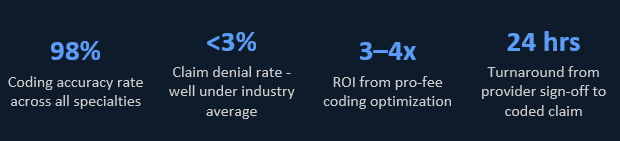
That 98% accuracy figure isn’t a marketing claim -it’s the product of a two-tier review on every chart. Primary coder, then supervisor. Both sign off before billing. The extra layer exists because errors in facility coding don’t announce themselves until a payer finds them, and by then the cost is already higher than whatever the review would have taken.
What also sets Nivaran apart is that their coders don’t just process volume. They read documentation. They flag gaps that undermine claims. They escalate to providers when a record doesn’t support what was billed -before the claim goes out, not after the denial arrives. Over 400 health systems, practices, and community health organizations across the country have made that workflow their standard.
Facility Settings Covered
- Hospital outpatient departments and inpatient facilities
- Emergency departments
- Ambulatory surgery centers (ASCs)
- Cardiology, radiology, and orthopedic specialty clinics
- Federally Qualified Health Centers (FQHCs)
- Community health centers and primary care networks
Not sure where your revenue cycle stands?
Nivaran offers a complimentary coding assessment for new clients -a direct look at where your claims are holding up and where they’re not. No commitment required to get the findings.
→ Request a Free Assessment → Read Client Stories
How Nivaran Prices Facility Coding
Per-claim pricing. A fixed fee for each date of service coded -regardless of chart complexity, regardless of time spent. No hourly rates that expand without warning. No monthly retainers that stay flat while your volume fluctuates.
The model is transparent by design. You know what each claim costs to code, and you can put that number directly against what that claim collects. For most facilities, that comparison is clarifying -and the ROI becomes easy to defend internally.
Because volume, specialty mix, and payer complexity vary significantly across facility types, Nivaran builds proposals specific to each organization. Contact their team for a quote that reflects your actual situation rather than a generic tier.
What Organizations Say After Working With Nivaran
The metrics matter. So does the day-to-day reality of what it’s like to have a coding partner who actually delivers.
Four Places This Shows Up in Your Revenue Cycle
Accurate facility coding isn’t an abstract quality metric. It moves specific numbers -ones that show up in reports your leadership team already watches.
First-Pass Acceptance Rate
Every claim that gets denied and resubmitted costs staff time and delays cash flow. If a timely filing deadline passes during that back-and-forth, the payment is simply gone. When coding is right before it leaves your system, it clears payer adjudication on the first attempt. Nivaran’s two-tier review process is built specifically to solve this problem at the source rather than cleaning it up after the fact.
Denial Rate
Most facilities working with Nivaran see denial rates fall within the first quarter. The benchmark they hold themselves to is under 3%. Industry average, depending on specialty, typically runs between 5 and 8 percent. That gap, multiplied across annual claim volume, is a number worth calculating for your own organization.
Audit Posture
CMS reviews, RAC audits, and commercial payer investigations happen. When they do, the outcome depends entirely on whether your coding was documented, defensible, and consistent.
Risk Adjustment Capture
Under value-based contracts, HCC diagnoses that are clinically supported but missing from claims translate directly to reimbursement you’ve earned but haven’t collected. Nivaran has certified risk adjustment specialists who review charts specifically for this -not to add codes without support, but to ensure every diagnosis with documentation behind it actually makes it onto the claim and into your reimbursement.
Frequently Asked Questions