
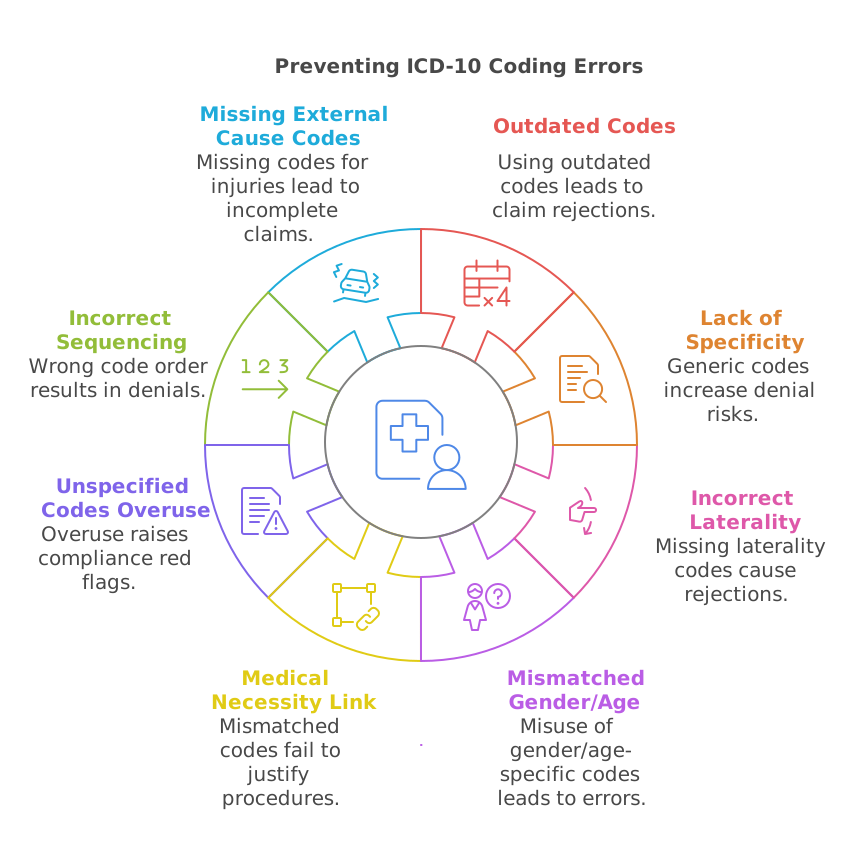
Healthcare providers must ensure precise coding to maintain smooth revenue cycle management. Here are the most common ICD-10 coding errors and how to prevent them.
1. Using Outdated or Incorrect ICD-10 Codes
ICD-10 codes are updated annually by the Centers for Medicare & Medicaid Services (CMS). Using outdated codes often results in claim rejections.
Example: If a provider uses M54.5 (Low back pain) instead of the updated M54.50 (Low back pain, unspecified), the claim may be denied.
✅ Solution: Nivaran ensures its medical coding services are aligned with the latest ICD-10-CM updates to prevent such errors.
2. Lack of Specificity in Diagnosis Codes
ICD-10 demands detailed specificity. Generic or unspecified codes increase denial risks.
Example: Instead of using J18.9 (Pneumonia, unspecified organism), a more specific code like J15.0 (Pneumonia due to Klebsiella pneumoniae) should be used when applicable.
✅ Solution: Nivaran's facility coding services ensure accurate, detailed coding based on complete clinical documentation.
3. Incorrect Laterality Codes
Many ICD-10 codes specify laterality (right, left, bilateral). Missing or incorrect laterality can lead to rejections.
Example: M25.561 (Pain in right knee) vs. M25.562 (Pain in left knee) – choosing the wrong side results in a claim denial.
✅ Solution: Our medical coding services verify laterality coding by cross-checking with clinical records.
4. Mismatched Codes with Patient’s Gender or Age
Certain codes are gender- or age-specific. Misuse leads to immediate rejection.
Example: Using N40.0 (Benign prostatic hyperplasia) for a female patient will be flagged as an error.
✅ Solution: Nivaran’s compliance auditing team ensures demographic compatibility in coding.
5. Failing to Link Diagnosis Codes with Medical Necessity
Payers require ICD-10 diagnosis codes to justify medical procedures. Mismatched codes result in denials.
Example: Submitting R10.9 (Unspecified abdominal pain) for an appendectomy claim will likely be denied due to insufficient specificity.
✅ Solution: Our denial management support ensures correct ICD-10 to CPT linkage for medical necessity.
6. Overuse of Unspecified Codes
Unspecified codes should be used only when clinical details are unavailable. Overuse raises compliance red flags.
Example: C80.1 (Malignant neoplasm, unspecified site) is discouraged unless absolutely necessary.
✅ Solution: Nivaran trains providers to enhance documentation quality, minimizing unspecified code usage.
7. Incorrect Code Sequencing
Certain conditions require primary and secondary ICD-10 codes in a specific order. Incorrect sequencing results in denials.
Example: In diabetes with complications, E11.621 (Type 2 diabetes mellitus with foot ulcer) must be sequenced before the ulcer code L97.529.
✅ Solution: Our team follows ICD-10 guidelines for precise sequencing and correct claim submission.
8. Missing External Cause Codes
For injuries and accidents, payers often require external cause codes (V, W, X, Y series).
Example: If a patient was injured in a car accident, a code like V43.52XA (Driver injured in a collision with a truck, initial encounter) should accompany the injury diagnosis.
✅ Solution: Our experts ensure external cause codes are applied where needed to provide complete claim details.
Conclusion
Improve ICD-10 Coding Accuracy with Nivaran
Avoiding ICD-10 coding errors is key to reducing claim denials, improving reimbursement rates, and maintaining compliance. Nivaran’s expert medical coding services help healthcare providers prevent these errors through:
✅ Comprehensive coder training & audits
✅ Real-time claim validation
✅ Updated coding software & compliance checks
✅ Denial management support
Partner with Nivaran for accurate ICD-10 coding and seamless claim processing.
📞 Contact us today to streamline your medical coding process!